2027 UF Guide to AI in Science
AI is radically redefining the nature of scientific inquiry — for better and for worse.
In Fall 2026, faculty, graduate students, and postdocs across multiple departments at the University of Florida came together to understand this urgent development. In a seminar titled Collective [Artificial] Intelligence in Science, we documented and discussed how AI is changing each component of our research workflow. This includes project management, idea development, data analysis, writing, and dissemination. To push our understanding, we alternated between the perspectives of an AI zealot and an AI critic — identifying key resources, consensus statements, and areas of disagreement along the way. The result is a resource adopted in courses and labs the following semester: the 2027 UF Guide to AI in Science.
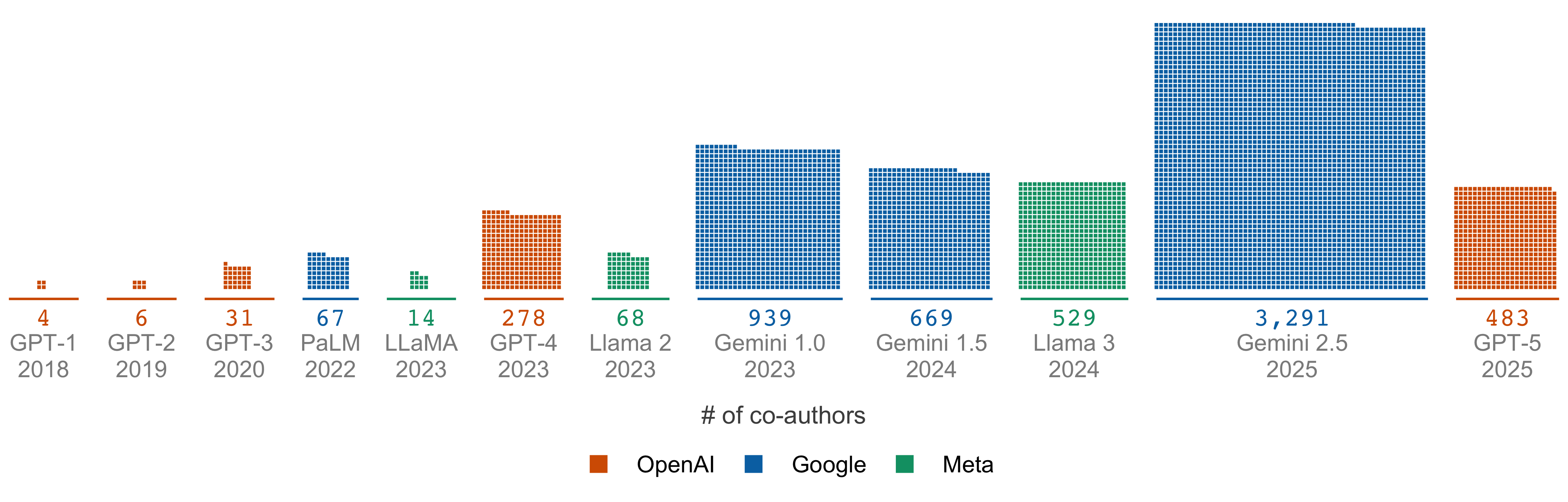
The seminar began with an introduction to big-team science — its rise1, competitive advantages2, and relevance to the current moment. For instance, the paper describing OpenAI’s GPT-1 had 4 authors3; the paper describing GPT-3 had 31 authors4; and the paper describing GPT-5 had 483 authors5 (Figure 1). In the artificial realm, a prominent AI-led cybersecurity attack on the online community, Hugging Face, involved coordinated action among not one but hundreds of AI agents6. Similarly, over 10,000 AI agents recently exchanged approximately 5 million messages over 88 hours in order to solve the Navier–Stokes equations7 — one of the seven Clay Millennium Prize Problems. Whether it be human or artificial, some of our most impressive accomplishments are requiring something rarely formally taught in science: large-scale collaboration8.
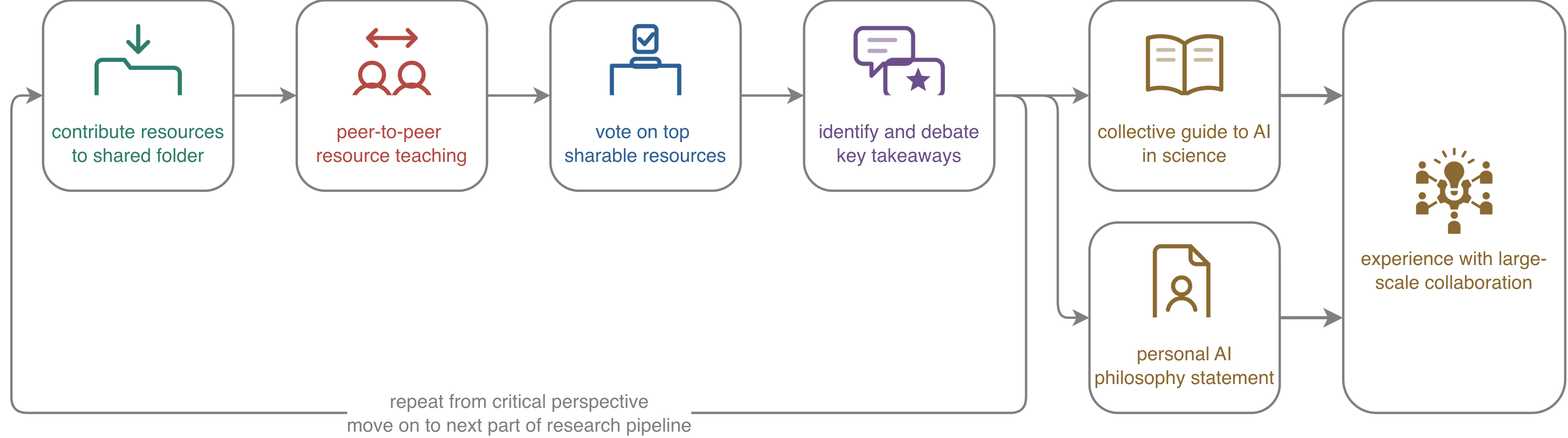
After reviewing this backdrop, the course itself became a large-scale collaboration, dedicated to understanding how AI is changing the nature of science. Each week followed a consistent structure (Figure 2). First, we would select a component of the research pipeline to examine (e.g., data analysis). Second, we would spend one week compiling resources for understanding the emerging role of AI in that part of the research pipeline. Third, we would engage in peer-to-peer teaching. Last, we would use a live online voting platform to solicit, debate, and vote upon key resources and takeaways for the week9,10. Through these exercises, seminar participants received hands-on experience with large-scale collaboration11. Along the way, they not only developed and debated their personal philosophy statements — but also the general direction of AI at UF. The collective effort culminated in this 2027 UF Guide to AI in Science: a summary of our top resources, takeaways, and disagreements.