Literature Review and Synthesis: Using AI
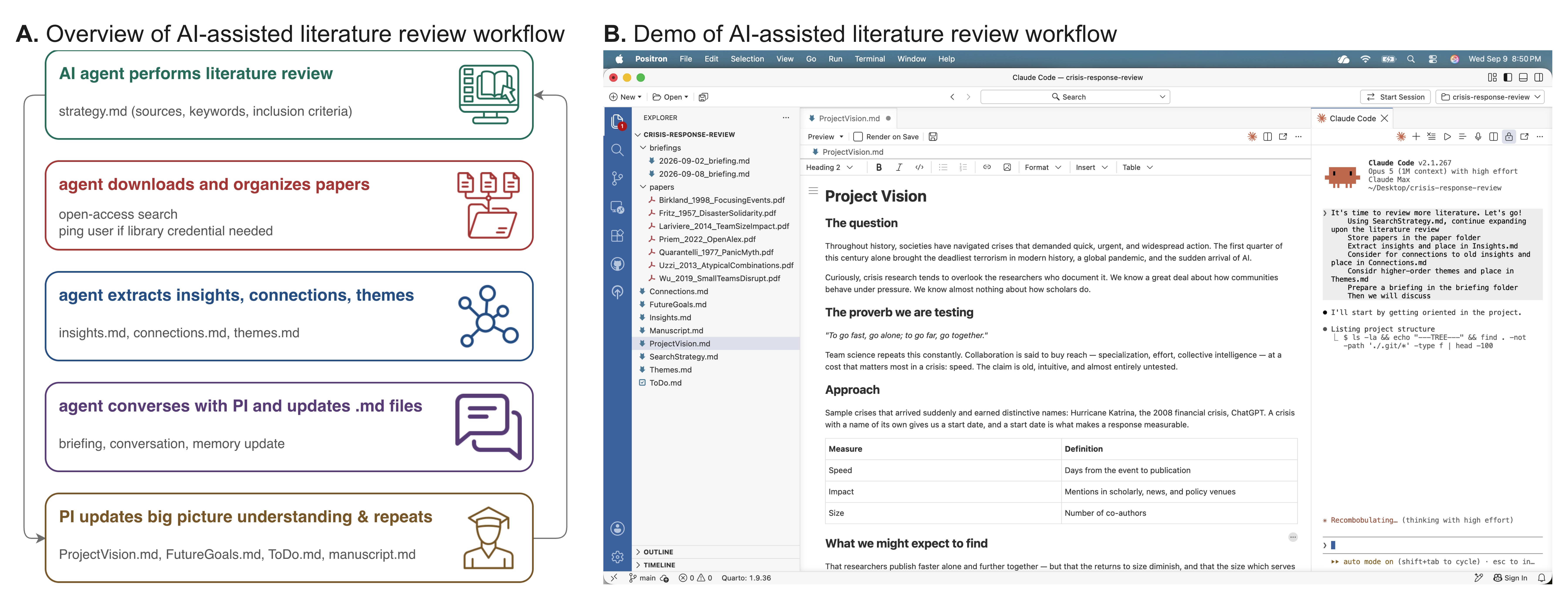
LLMs have an unprecedented capacity to conduct and assist with literature reviews — making them arguably one of the most essential additions to the modern-day research workflow (Figure 1). This week, an in-class demo focused on how the “days of research assistants, Google Alerts, and journal subscriptions” are being replaced by AI-assisted workflows (Figure 2). For example, armed with markdown files for organizing search strategies, key insights, and overarching project goals, one demo deployed Claude3 to (a) search, screen, and organize resources, (b) extract key insights, connections, and themes, (c) brief the PI on recent developments, and (d) adjust the project vision based on PI feedback (Figure 2, Panel B). This process runs automatically each week, allowing this researcher to sort through an increasingly growing and unmanageable scientific literature with more efficiency than ever before.
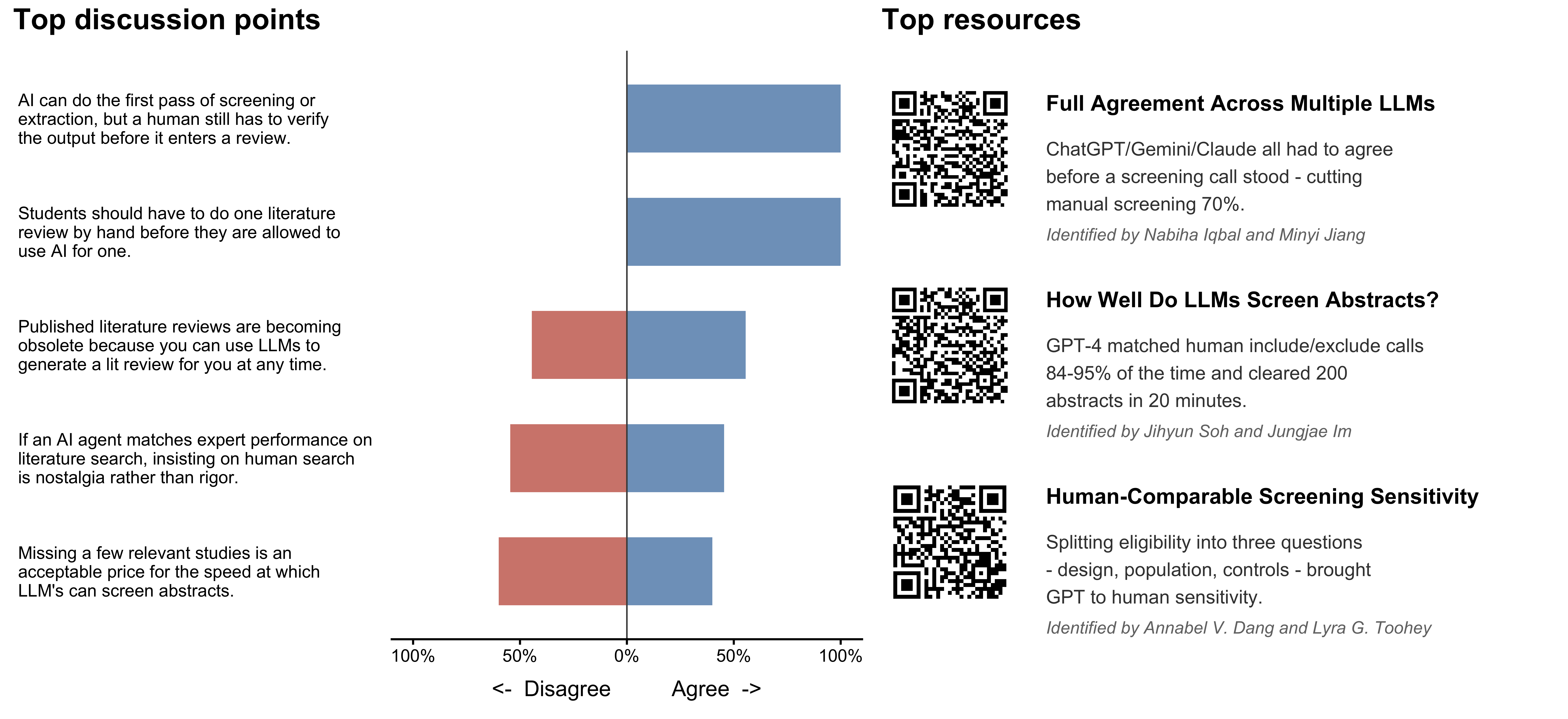
From custom workflows (Figure 2) to LLM skills4 to off-the-shelf tools like Consensus2, resources compiled by seminar participants painted an overwhelming picture: AI has already revolutionized the literature review space. For example, an early evaluation demonstrated that LLMs are capable of reviewing up to 110 research records per minute, often achieving accuracy comparable to human coders who need months for the same task5. However, not all models are created equal — with some performing at human-level accuracy and others landing at the floor6. This has led to new programs of research dedicated to optimizing these AI systems. For example, AI agents are capable of performing more accurate literature reviews when allowed to work in teams7 — an insight that parallels many of the collective intelligence themes reviewed in this seminar8–10 (see Preface).
Areas of consensus — and dissensus
Working in a team setting, of course, requires navigating both consensus and dissensus11,12. In terms of consensus, there was strong agreement that AI tools are ubiquitous in literature review, with browser-based applications like Consensus2, Gemini Notebook13, and ChatGPT1 providing non-technical entry points for nearly all researchers. Furthermore, there was agreement that such workflows are still relatively novel, indicating a strong need for continued evaluation and reflection. As part of this reflection, we reached our sharpest disagreements. Are systematic reviews still noteworthy contributions to science? Are we ready to rely upon these tools in our own research? And, if so, what’s left for humans?
“What’s left for humans?” was not an abstract question. Nearly every seminar participant considered literature reviews an essential part of their initial training. Yet, many also acknowledged that they’ve largely stopped offering these same training opportunities in their own labs. In the ultra-competitive and fast-moving world of science14, many researchers simply feel they cannot afford to lose the speed advantage of LLM-assisted literature review. Seminar participants had mixed emotions15 about these developments. For example, some people noted the extremely unpleasant nature of a literature review assignment. One participant likened the notion of having a human spend months on a literature review task an LLM can complete in hours to “academic hazing”. Others suggested it’s a necessary skill to develop, but not to personally practice – akin to learning long division before being handed a calculator. Yet, even if that is the case, a philosophical tension remained. Every academic in the seminar has been collectively entrusted by society to understand, maintain, and develop the scientific record. What does it mean when we are increasingly disengaging from that literature directly? To what extent had we already done so far before the arrival of AI? Themes such as these became the focus of the following week of the Fall 2026 Collective [Artificial] Intelligence Seminar (see Literature Review and Synthesis: Critiquing AI).