Ideation and Project Management: Critiquing AI
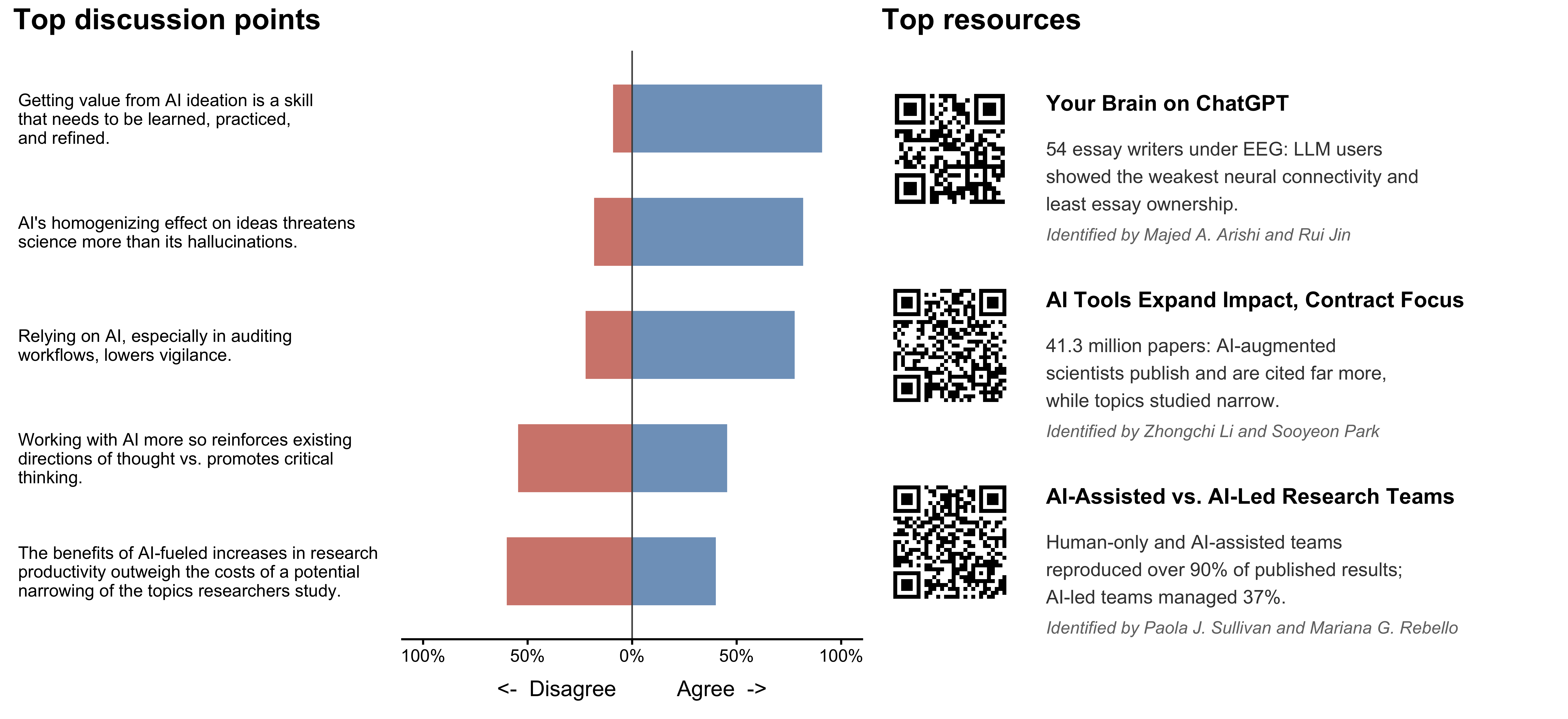
In February 2026, an engineer running an online educational program used Claude Code2 to help launch a new side project. Instead of launching something new, they ultimately deleted everything they had already built: servers, networks, and years of datasets. The failure point, the engineer would later suggest, was over-automation3. The engineer never checked whether backups could be restored; they never pushed back on questionable recommendations from the coding agent; and they allowed it to run irreversible commands completely unsupervised. Issues like these are bound to become more common as scientists increasingly rely on AI — the focus of Week 3 of the Fall 2026 Collective [Artificial] Intelligence Seminar (Figure 1).
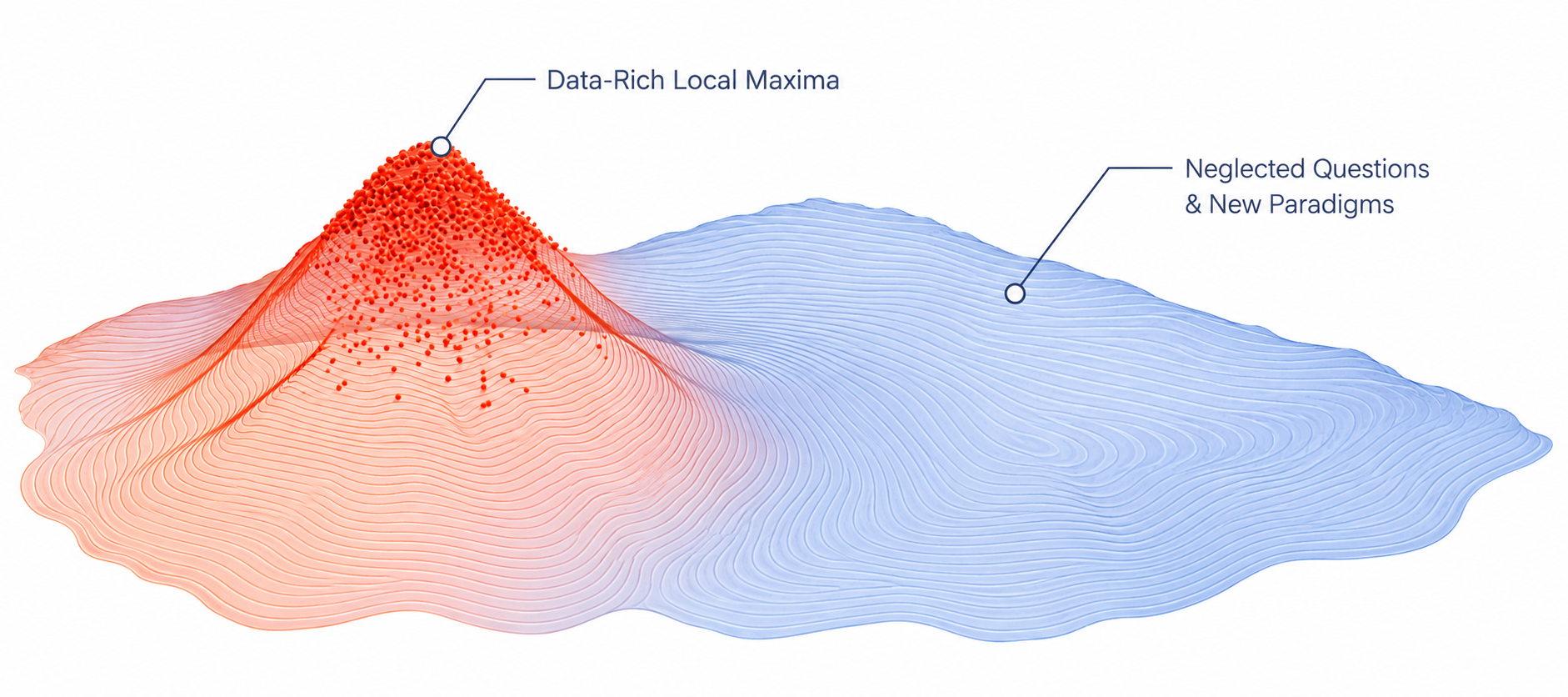
This week’s most popular resources focused on the pitfalls of using AI for ideation and project management (Figure 1). For example, one seminar participant presented a study that used electroencephalography to measure brain connectivity patterns while writing alone, with a search engine, or with an LLM. Results suggested that LLM users exhibited the lowest levels of distributed brain activity — an index of lower cognitive engagement4. Similarly, when researchers rely more on AI for routine tasks like reproducibility checks, they catch fewer errors, propose weaker robustness checks, and ultimately move slower5. As scientists continue this shift towards AI, collective implications emerge. For instance, an analysis of 41 million research papers suggests that the adoption of AI tools and methods increases productivity, impact, and career outcomes for individuals — but at the expense of an overall narrowing of the scope of science6 (Figure 2).
Areas of consensus — and dissensus
Particularly after focusing a prior week on the benefits of AI, seminar discussion was marked by areas of consensus and dissensus7,8.
In general, there was strong agreement that concerns about AI have evolved beyond hallucination proneness9. Decreased vigilance and a collective narrowing of science received more attention among seminar participants — with near-unanimous agreement that maximizing value from AI requires training, practice, and refinement10. Yet, there was clear disagreement about the magnitude of the issue. Does AI hinder more than help with critical thinking? In the midst of widespread concerns about the robustness of existing research practices11, to what extent should we aim for increases in productivity? Last, is a narrowing of the scope of science necessarily a bad tradeoff12? After all, depression, addiction, cancer, dementia, climate change, and polarization are arguably enduring problems in need of sustained focus. Whether those problems are solved more quickly through increases in individual productivity, decreases in collective scope, and a faster overall science remains an open question. Such questions would be immediately revisited the following week, where we focused on AI’s emerging role in literature review and synthesis (see Literature Review and Synthesis: Using AI).